EU AI Act Design System
A Figma and React design system for AI governance products, built around what the law actually asks: classify, prove, and report before the clock runs out.
- Role
- Lead product designer
- Scope
- Research, 79 components, 15 screens, React library
- Built with
- Figma variables, React, Radix Primitives
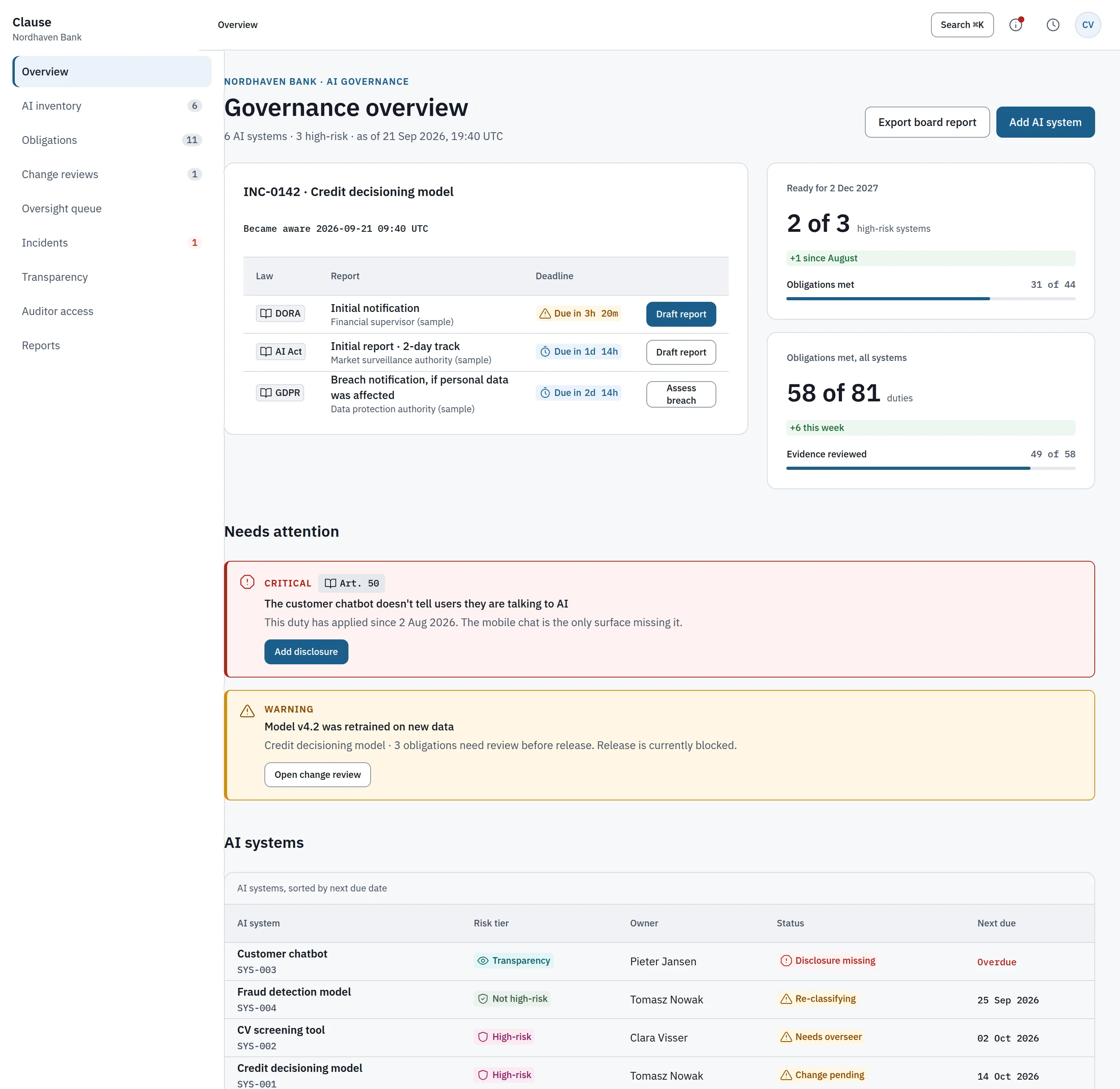
Governance tools treat the AI Act as a checklist. The law runs on clocks and changes.
A checklist says a system is compliant. The Act asks what happens when the model changes, when something goes wrong, and when an authority questions a decision. I designed for those three moments.
A retrain can quietly break compliance
Evidence, evaluations and the technical file describe one model version. Retrain it, and they no longer apply until someone checks again.
One incident, several legal clocks
The AI Act, DORA and GDPR each start their own deadline from the moment you became aware, and they don't wait for each other.
A classification is a decision you must defend
"Not high-risk" is allowed under Art. 6(3), but an authority can challenge it, so the reasoning has to be on record.
Four decisions I'd defend in any design review
Each one is built into the components, so a team using the system gets it without having to remember it.
Status is never colour alone
Every risk tier, stage and clock pairs its colour with its own icon and word, so it still reads in greyscale and for people with colour blindness. Try it: the switch turns every chip in this section grey.
A state word can't contradict its value
"Below threshold" is fixed to the component state; only the number is editable. A chip can never say "Pass" next to 71%.
The earliest deadline leads
Clocks count from "became aware", sort earliest first, and only the first is a primary action. Under six hours always reads as due soon.
Every decision leaves a record
Classifications, overrides and freezes are written with who, why, when in UTC, and the article. The trail has no edit or delete.
Clara Visser changed the tier from Minimal to High-risk: "Purpose now includes credit limit decisions, which is Annex III 5(b)." 21 Sep 2026, 09:40:12 UTC · Art. 6
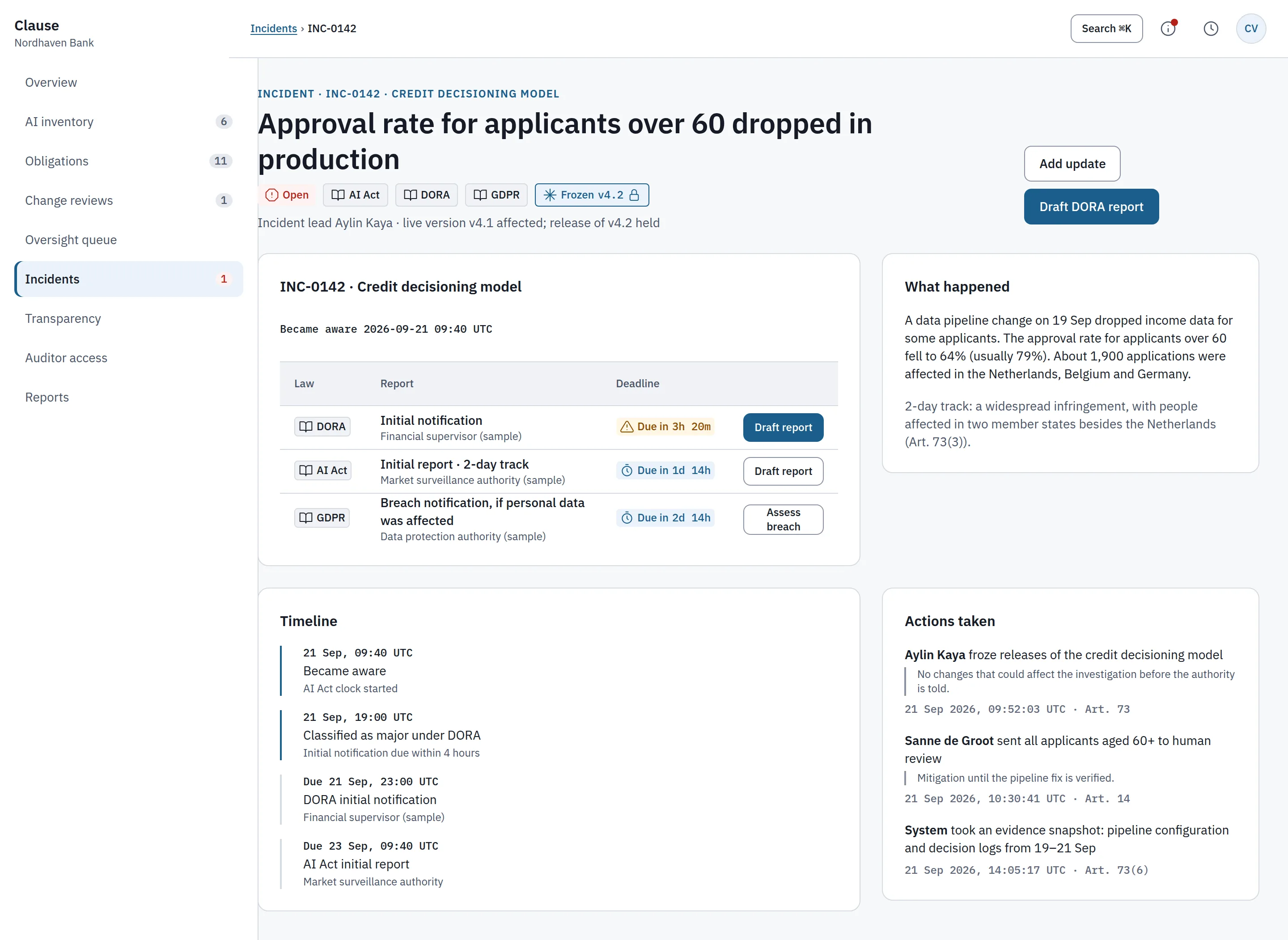
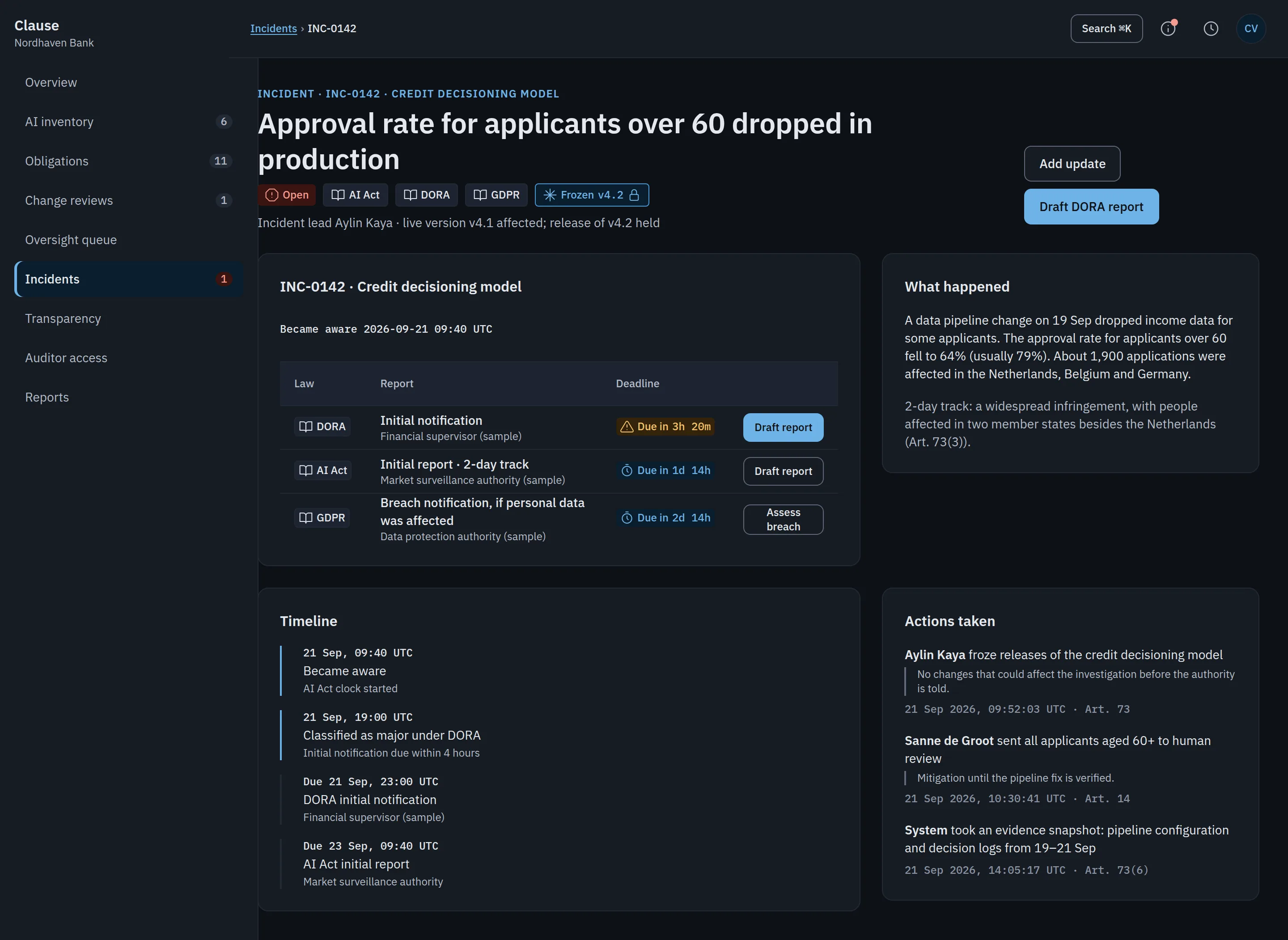
One set of tokens, two themes, every screen built from components
Colour, type, spacing and density live in Figma variables with Light, Dark and Compact modes. The same names become CSS variables in code, so a designer's spec and a developer's component read alike.
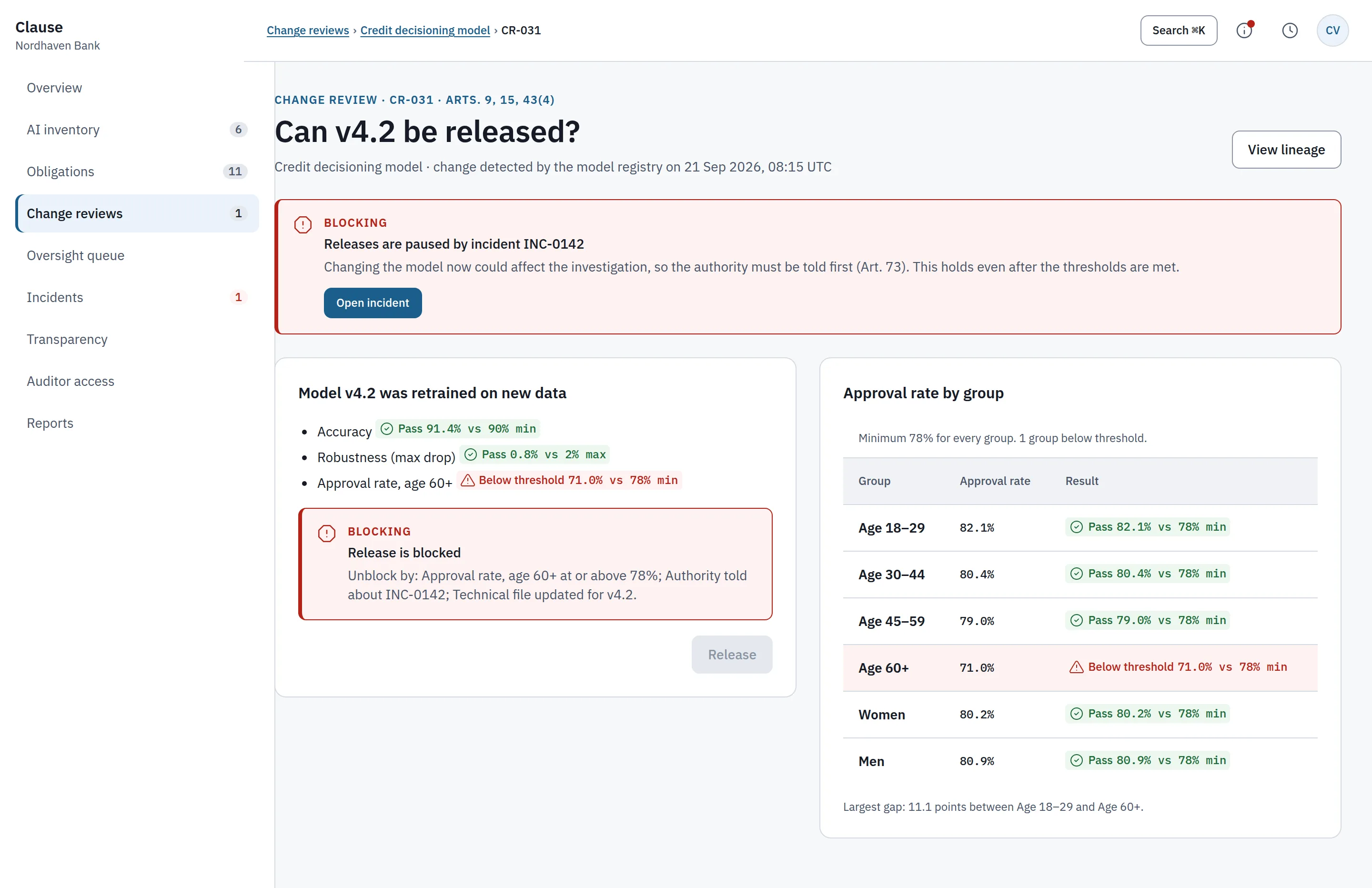
"I retrained the model. Can I ship?"
A material change resets the evidence behind a high-risk system. The change review turns that into a gate with a clear answer, instead of a report someone has to interpret.
Detect the change
New training data counts as a material change, so the review starts before anything reaches customers.
Re-run against thresholds
Every metric shows its value, its threshold and the certified version, so a drop is visible even when it still passes.
Release or block
Release stays disabled and says exactly what unblocks it, including an open incident that freezes the model.
Designed in Figma. Built in React.
Every variant value is a prop value, and the legal logic is code with tests, so a clock or a release gate can't drift from the design.
import { IncidentClockPanel, releaseGate } from "./euaiact-ds";

const gate = releaseGate([
  { label: "Approval rate 60+ at or above 78%", met: false },
  { label: "Authority told about INC-0142", met: false },
]);
// gate.canRelease === false, gate.blockers.length === 2- One file, every component. euaiact-ds.tsx with the tokens and styles embedded, on Radix Primitives.
- 177 automated checks for logic, rendering and keyboard use, including every deadline and chart value shown in the Figma screens.
- WCAG 2.2 AA: axe finds 0 violations, and a screen-reader readiness check runs on a composed screen.
- One source of tokens for Figma and code, with a contrast gate on every colour pair in both themes.
Use it in your product
The Figma file has a free version with the foundations, all eight EU AI Act atoms and 15 components, plus previews of everything else. The full kit adds every component in all sizes, the domain components, charts, all fifteen screens (including post-market monitoring, AI literacy and vendor assessment) and four maps, from $49, or $119 with the React library.
Building an AI governance product?
I design for fintech, healthcare and compliance software. If you're working on AI governance, model risk or the EU AI Act, I'd like to hear about it.